In 2017 we ran a survey of Stitchmastery users and one response particularly caught our imagination – someone told us they would like to hear from other Stitchmastery users and how they make use of the software. We’re delighted to bring you a series of interviews with designers, tech editors, magazine editors and teachers – we hope you enjoy reading them!
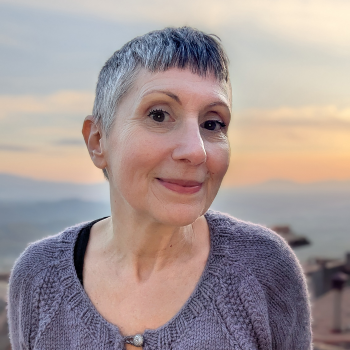
Interviewee – Paola Albergamo
1) When did you start designing? Could you give us a potted history of your knitting and designing background?
I learnt to knit relatively late, at 15, because nobody in my family really did it. I immediately enjoyed it and since then, I never stopped knitting. I even took my yarn with me in several international moves around Europe.
As many other designers my age, I started designing long before I was even aware of doing it. Back then, finding a pattern that matched your size, yarn, or taste was nearly impossible. I always had at least to recalculate everything, so often it was easier to design things from scratch.
I started sharing my designs only much later, when I discovered Ravelry and realized that writing and publishing your own patterns was a thing.
My first published pattern came out in 2014 and for a while, designing coexisted with my freelance work as a programmer, but gradually knitting took over. Over the years, I’ve shifted from practical pieces (like sweaters, hats, bags, mitts) to shawls, which I once dismissed as purely decorative. They give me a lot of space to experiment with structure, geometry, techniques and colors.


2) Do you have any recurring sources of inspiration or unusual muses for your design work?
I’m not sure I have recurring sources of inspiration. I’m inspired by everything and also nothing in particular. Sometimes ideas just appear, and only later do I understand why they made sense. A landscape, a book or a movie, a texture, a shape, and even writing on a wall – they all mix somewhere in my head and eventually turn into stitches. Most of the time, I understand what a design means only once it’s finished.

3) When you have an idea, do you always work to a set workflow (eg swatch-knit-chart or chart first then knit) or does your approach change with each design?
My usual workflow is swatch → chart → knit. I like to start with yarn in my hands to understand the texture and flow before translating it into a chart.
But it depends on the technique. When I’m working in something I know well, like mosaic knitting, I often begin directly with a chart (a sort of “cold draft”) and only swatch afterwards to see how it behaves in yarn. For techniques that are more fluid or experimental, I prefer to start with the needles. The swatch comes first, then the chart, then the actual piece. What I never do is knit first and chart later. How is this even possible?
And of course, that’s only the beginning. Once the knitting works, there’s still the writing, editing, translations, photos, testers, layout, and everything else that turns an idea into a real pattern.

4) What made you choose to use Stitchmastery? Is there a particular feature you use most regularly or couldn’t do without? And is there anything you wish Stitchmastery could do?
I started using Stitchmastery because it was (and still is, I think) the industry standard. When I began publishing with magazines, it was the format they preferred (both Knitty and Knotions worked with Stitchmastery files, I believe) so being able to send charts and written instructions directly from the software helped me a lot.
The features I use the most are the custom stitch libraries and the automatically generated written instructions. I cannot even think to design without these features.
What I really wish Stitchmastery could do is the ability to duplicate custom stitches from one library to another. I need two separate English and Italian libraries, and I have to recreate the same stitches just to keep them identical in both versions.

5) Please tell us about your latest publication or next exciting project!
My latest publication is Lady Floriombra, a shawl inspired by a fictional and mysterious Renaissance embroiderer who suddenly disappeared without trace. The shawl/stole has a sort of almond shape, with pointed tips and it’s worked in a technique that I call Filigree, that is an easy technique that mixes marling and mini cables and/or lace, with the help of mohair yarn. The result is a “lighter than air” marlisle.
As a thank-you to Stitchmastery readers, you can use the code STITCHMASTERY for 25% off Lady Floriombra until November 22 in my Ravelry store – https://www.ravelry.com/patterns/library/lady-floriombra.

My next release will be Shiftling, a shawl that explores what happens when short-row colorwork meets shawl shaping, a fun and engaging knit with a modular twist.
The coming year is already full of projects I’m truly excited about, most of them shawls built around techniques I love experimenting with: the above mentioned Filigree, mosaic and Echo Knitting (a mosaic variant that changes color on every row), dip stitches, and short-row colorwork and shaping. Let’s just say my publishing schedule is full until late 2026!
Learn more about Paola:
You can find Paola’s designs on Ravelry. To keep up to date with her, you can follow Paola on Instagram or follow Paola on Facebook. You can also join Paola’s newsletter list.
