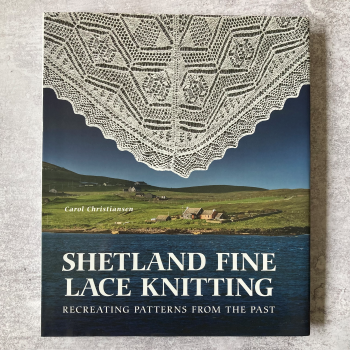
Carol Christiansen is Curator of Collections at Shetland Museum and Archives, and author of “Shetland Fine Lace Knitting – Recreating Patterns from the Past” which was published in 2024 and which uses Stitchmastery charts. We met with Carol to learn more about the book and the lace knitting traditions in Shetland.
What is the Shetland Fine Lace Knitting book and what prompted you to write it?
So the main impetus for creating this book was that we (at the Shetland Museum and Archives) have a very large collection of Shetland lace knitting, probably the largest collection that exists. And globally there’s a lot of interest in Shetland lace – from people that just want to see it, but also from knitters who want to recreate it. It’s difficult for people to get access to the lace pieces, partly because of our geographical location, and partly because it’s really difficult to put out a whole lot of pieces of lace and let people handle them. One shawl will take up the whole of the table that we have for researchers. And so in order to provide access to the collection, which is a big part of what my job is about, I thought, how can we get lace out there so people can understand what Shetland lace is and look at not only the variety of Shetland lace design, but also how similar a lot of it is in terms of the way that it’s laid out and the design structure of it all. How can we get that knowledge across? Because I see a lot of so-called “Shetland lace” on social media, that isn’t Shetland lace. It’s lace knitting, and maybe once in a while, they’ll use a pattern that’s common in Shetland lace knitting. But the way that it’s designed, the structure of the piece, isn’t the traditional way that Shetland lace was made. And I understand that these kinds of techniques and traditions change – they need to change to stay current, and they were always changing, even in Victorian times, because they were trying to keep up with fashion, and to also be competitive with the beginnings of machine-made lace. But still, I think it’s important to keep in mind what the formula of Shetland lace structure was. And if you know that, to begin with, and you have a good idea of the huge repertoire of patterns, you can do anything with it after that. We wanted to provide access to these pieces in the collection that are otherwise really difficult to give knitters access to, so that everyone can gain a better understanding of what the Shetland lace tradition actually consists of. It was important to show what has come out of Shetland about which we can definitively say “this is Shetland lace”.

We wanted to present this range of motifs for both experienced knitters and very beginning lace knitters. So the idea was to show some really simple patterns, which can be really beautiful – there’s a lot of lovely lines and a beautiful flow of design in some of the really simple patterns. And then you have the really complex ones, which are completely mind-blowing in some cases. It’s not a book that tells you how to make a shawl, because there are other books that tell you that. It’s a book that you can use to design your own, using anything from three patterns – one for the border, one for the lace edge and one for the centre – to a whole load of patterns.
Another aim of the book was review some of the history that we’d researched, sometimes about specific pieces which are in a separate chapter at the end, and also to have a critical look at design development overall. There are not many pieces that are accurately dated, so it’s hard to put Shetland lace designs into chronological order because we don’t know what age the pieces we have are. But there are some pieces that you have a sense are much earlier than others, whether that’s through the yarn quality (one easy marker is when commercially spun yarn became available) or the construction or the wear. Certain patterns appear for a while and then they disappear and you never see them again. So it was important to try to see how Shetland lace changed over time in its design. Towards the end of the 19th century, it did develop this almost kind of formulaic way of approaching it with a fairly set repertoire of patterns and not necessarily creating anything new. And the placement of those patterns, especially in stoles and, in some cases, shawls, tends to be the same over and over again.
We had two workshops within Shetland to talk about lace motif names. There were a lot of silences because a lot the motifs didn’t have names passed on with them to the knitters of today, so a lot of names were lost. Some patterns maybe never had names, or the name wasn’t passed on because that pattern was so rarely used or unique to one knitter who maybe only knit it into items which were sold to people on the UK mainland and never seen by other local knitters. And then other motifs might be known by different names across the islands, e.g. in Unst, Northmavine and Dunrossness. So we recorded what we could of the names, and for some of the patterns where we didn’t have a name, we called them “tree one” or “tree two” or something along those lines, because we didn’t want to put a poetic/non-literal name to it that was like fake history – that would perpetuate these weird historical myths and inconsistencies.


Some background to the lace pieces
I just cannot quite fathom how people designed and knitted these beautiful items back then. I find it just mind blowing – before electric lighting, before proper eyeglasses, before calculators, spreadsheets and charting software, maybe in a house with a central fire and chickens and children running around, and often multiple generations living together. It was a much more sociable time as well, people visiting each other very regularly without pre-arrangement and you wonder, did the women take themselves away at some point to sit quietly with other lace knitters? And likely helping each other out. Bearing in mind, they were almost always working from their head, without much in the way of written notes (though sometimes people did hand draw basic charts or make little swatches, though we don’t have a huge amount of either in our collection), so figuring out things like how to fit motifs into a section that was changing shape – it must have taken a huge amount of concentration. To me it’s just one of the most exquisite textile crafts in the world and yet it often came out of such tough conditions. And I think the Victorians appreciated it for that. I think they saw these beautiful pieces and thought, how could that come from that place so far away with people living quite hand to mouth? And we’ll never really know how it did come to be. The reason for Fair Isle knitting starting out is a lot simpler to understand – people needed warm clothing. But intricate lace shawls were rarely worn by the people who knit them. The purpose was to sell them, but where it started is not really documented. And the knitters were pretty anonymous, certainly until the end of the 19th century, when transport links improved and you could start to have your own customer base, but all those thousands of pieces of Shetland lace that were knitted between say 1840 and 1880, they were knit by women who, for the most part, were largely anonymous. They went to a merchant, the item got sent away, and somebody fairly well-to-do in some city south bought it, and never had a sense of who knitted it, or what the knitter’s situation was, or the spinner’s for that matter. I suppose a lot of the clothing industry today is so much the same.


The charting process and Stitchmastery
To me, in modern day knitting you have to have a chart, and the book publisher also wanted the written out instructions – some people work better with the written out. The beauty of Stitchmastery was that we got both at the same time, and if we changed something in the chart it would change the written version automatically. I’m not really a lace knitter but to me, a chart is easier to understand and to also have a sense of what it’s going to look like. I don’t think you can tell that from a written out pattern at all – I need to see the graphic, I need to see what that is. And it also tells me whether or not I want to even tackle it. Anne Eunson was one of the knitters who worked closely with us on the project and she was already familiar with Stitchmastery. She was going to be the one charting the patterns from the various items of knitting and we needed to go with something that she was comfortable with and could easily use.
When Anne and Kathleen Anderson first came and started to look at things, it was interesting to see their reaction because they’d never really looked at the collection or that many pieces in the collection before. Between the two of them though, they’d seen a lot of lace and they’d made a lot of lace, and yet they came across things they’d never ever seen before and they were really excited about that. And the thing is, we have to be quite careful with these pieces because you’re looking at the originals, you can look at both sides but you can’t just take it apart and actually follow the yarn. So they had to make their best guess and knit it and check, “does it look exactly like what is in front of me?”. But there were a few times that they couldn’t really work out how to recreate sections, there were a couple of items with twisted stitches which you don’t really see in Shetland knitting. So there were items we rejected for the book because we didn’t think they were strictly in the Shetland tradition. Other items we rejected included things that weren’t spun very well, or they’d been laundered, and so the yarns were a bit fuzzy, and it was really tough to see what was what. But, you know, a huge proportion of the collection is made from hand spun yarn, so a lot of it was really, really beautifully clear, so we had many other things to pick from.
One of the things that Anne told me, which I thought was really interesting is that in a lot of these pieces, the normal choice of 3-into-1 decrease is knit three together. But she said that when commercially spun cobweb yarn comes in, sometime around the end of the war or maybe into the 50s, knitters found they couldn’t do knit three together because the yarn would break. And so they had to swap to something else like s1, k2tog, psso. It really speaks to the strength of hand spun, even though the hand spun is finer than the cobweb.
When it came to knitting the motif swatches for the book, we had to make a decision about how closely we were going to try and match them, as the original garments were knit by different people with different tension, and often in yarn handspun by many different people too, so there wasn’t consistency. It became clear that it wouldn’t be practical to attempt to match this closely. So we chose to knit the swatches with commercially spun 2-ply lace yarn, and that gives people using the book the opportunity to see how a motif looks different in a different weight of yarn that they can actually access themselves.

Future projects
It’s been great to hear from people who email and say “I’ve got your book and I’m fiddling around with this, and this is what I’ve made” and it’s fantastic. Some people are really using the book, not just consuming the info but creating new things from it, which is great. Fair Isle is hopefully next on the agenda. We needed to get lace done because we were getting so many enquiries and it’s such a difficult thing to help people with through email. Fair Isle is maybe a bit easier to reverse engineer and understand, and there are a lot of books on it. Not so much lace. There are some really good books on lace but again, not all of it is specifically or accurately about Shetland lace. But we have a big collection of Fair Isle knitting too and the history of that is not immune from historical inaccuracies, just like the term “Shetland lace”, so reviewing the research and bringing some of the items to a wider audience is something I’d like to do.
Learn more
There are several articles about the lace project on the Shetland Museum and Archive website and the book can also be purchased from the Shetland Heritage Shop.
Thanks for the book! I have been to the museum in Lerwick and have cones of the cobweb yarn (plus a skein of lace weight). I like the way you arranged the patterns with written and charted instructions with two photos. I have a couple of projects going now.