
In 2017 we ran a survey of Stitchmastery users and one response particularly caught our imagination – someone told us they would like to hear from other Stitchmastery users and how they make use of the software. We’re delighted to bring you a series of interviews with designers, tech editors, magazine editors and teachers – we hope you enjoy reading them!
Interviewee – Janet Welsh
1) When did you start designing? Could you give us a potted history of your knitting and designing background?
I started knitting when I was 16. My mother was always working on some sort of needlework, but she didn’t knit. As I looked through her craft magazines I yearned for all the pretty knit sweaters. Since she couldn’t make them for me, I decided to learn for myself. My first sweater was a little bolero. My aunt helped me at a few points and my mother embellished it with crochet flowers. It was a fairly simple stockinette stitch project in worsted weight yarn. I’ve been knitting almost every day of my life since.
As for designing, there was a day about 15 years ago when I went out for dinner with a friend and she showed me a book of Latvian mitten patterns and I was in awe! I couldn’t believe the beauty in the book (Latvian Mittens by Lisbeth Upitis). I started knitting up some of the mittens and I couldn’t stop. I was charting my own mittens and soon people on Ravelry were asking me for my charts. I shared my charts and explained I wasn’t a designer. And then I thought, why can’t I be a designer?
My educational background is a degree in Human Ecology, which is a fancy way of saying Home Economics, with a major in Clothing and Textiles. Over time, my career path has led me to being a specialist in communications. I realized I could combine my educational background with my professional writing skills and love of detail to be a designer that writes and publishes patterns.
My first published design, Celtic Inspired Mittens, was released in 2015. Since then I’ve released 22 patterns that have been purchased by knitters in 25 different countries.

2) Do you have any recurring sources of inspiration or unusual muses for your design work?
My inspiration comes from many different sources. I don’t think I can point to a single recurring source.
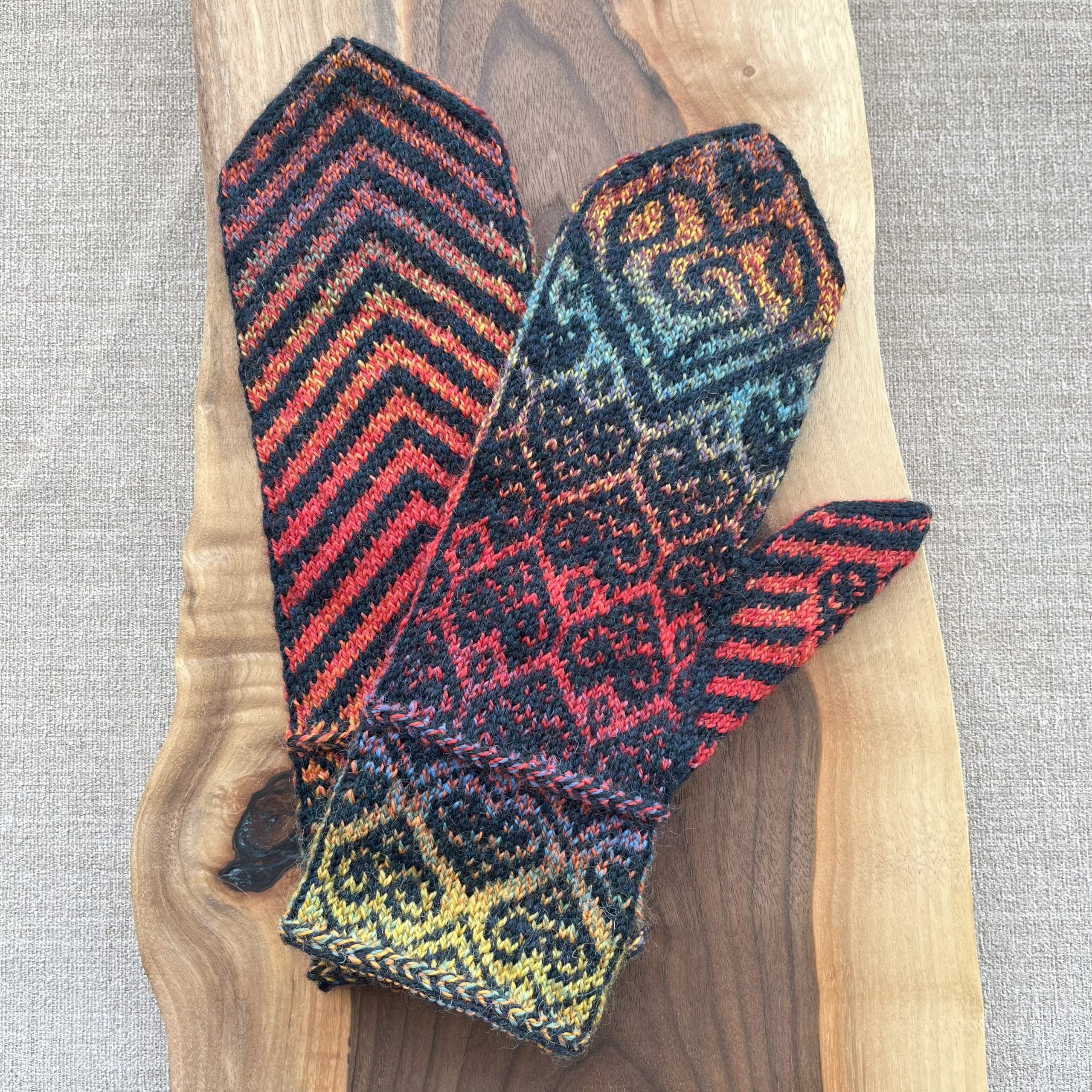
My first pattern was inspired by Celtic knots and featured hearts, which often pop up in my designs. I also love keeping my mind open to the nature around me. I live in Canada, where Autumn is a time when the changing colours are always inspiring. My most popular pattern is my Autumn Fade Mittens which was definitely inspired by the nature around me!
I have a big library of stitch dictionaries which serve as a bridge from the inspiration in my mind to what comes out in a mitten pattern chart. I’ll often have an idea in mind and then surround myself with all my stitch dictionaries and pull parts from a few different books to create a cohesive design.

3) When you have an idea, do you always work to a set workflow (eg swatch-knit-chart or chart first then knit) or does your approach change with each design?
I definitely chart first, then knit. I need to get the design down on “paper” before I bring it to life in yarn. Sometimes a design just flows right out of my brain into a chart and knits up beautifully. Other times, what is in my brain won’t quite make it into a chart and where I end is completely different from where I began. And there have been a few times when what looked perfect in a chart doesn’t look good at all when I knit it up.
I think people would be surprised to know how often I unknit a mitten. To get a good mitten design I probably rip back at least 4-6 mittens worth of knitting. I’ll take my chart, knit it up and realize it doesn’t work at all. Or maybe it mostly works, but some of the stitches need a little tweaking. Sometimes there’s more ripping back than moving forward, but in the end it is worth all the effort.
I also believe it is important to get the details right. I have worked with a few tech editors to get a pattern template where the words made sense. And for every design I knit up the pattern a minimum of 6 times, and usually more due to ripping back, to make sure the charts, words and math all align.

4) What made you choose to use Stitchmastery? Is there a particular feature you use most regularly or couldn’t do without? And is there anything you wish Stitchmastery could do?
When I began designing I used a spreadsheet. It was painful to colour in all the squares individually and have things move around when the program decided I must want to do something different. Then I switched to a professional designer’s program but the learning curve was steep and it was cost prohibitive. When I found Stitchmastery, I was instantly hooked. It is easy to learn, support through email or Ravelry is readily available, and the cost is very reasonable for a part-time designer.
Now, I can’t imagine designing without it! I use Stitchmastery to create all of my mitten charts. The ease of colouring in the different stitches and changing colours when I change my mind is great. I also love how easy it is to cut and paste motifs, or switch them up horizontally and vertically. That saves me so much time after I have my initial motifs settled. But where it is the most valuable is the ease with which I can copy charts and slice and dice them in different ways.
I believe in offering different size options, beyond just switching up the gauge to make a bigger or smaller mitten. So for every mitten design I create a small, medium and large size. And I’ve noticed that people have very different finger lengths or row heights, so I like to offer a regular and short length version for my designs. Also, I think it is fun to make a different right and left hand. In the end, a typical pattern for me will have at least 12 different charts.
Each September I like to run a mystery knitalong in the I Make Mittens Group on Ravelry. For that, I need to take all those different size and length charts and chop them up into different clues. For my most recent mystery knit I ended up with 51 different charts for all the clues and full pattern. I couldn’t have done that efficiently without Stitchmastery!
5) Please tell us about your latest publication or next exciting project!
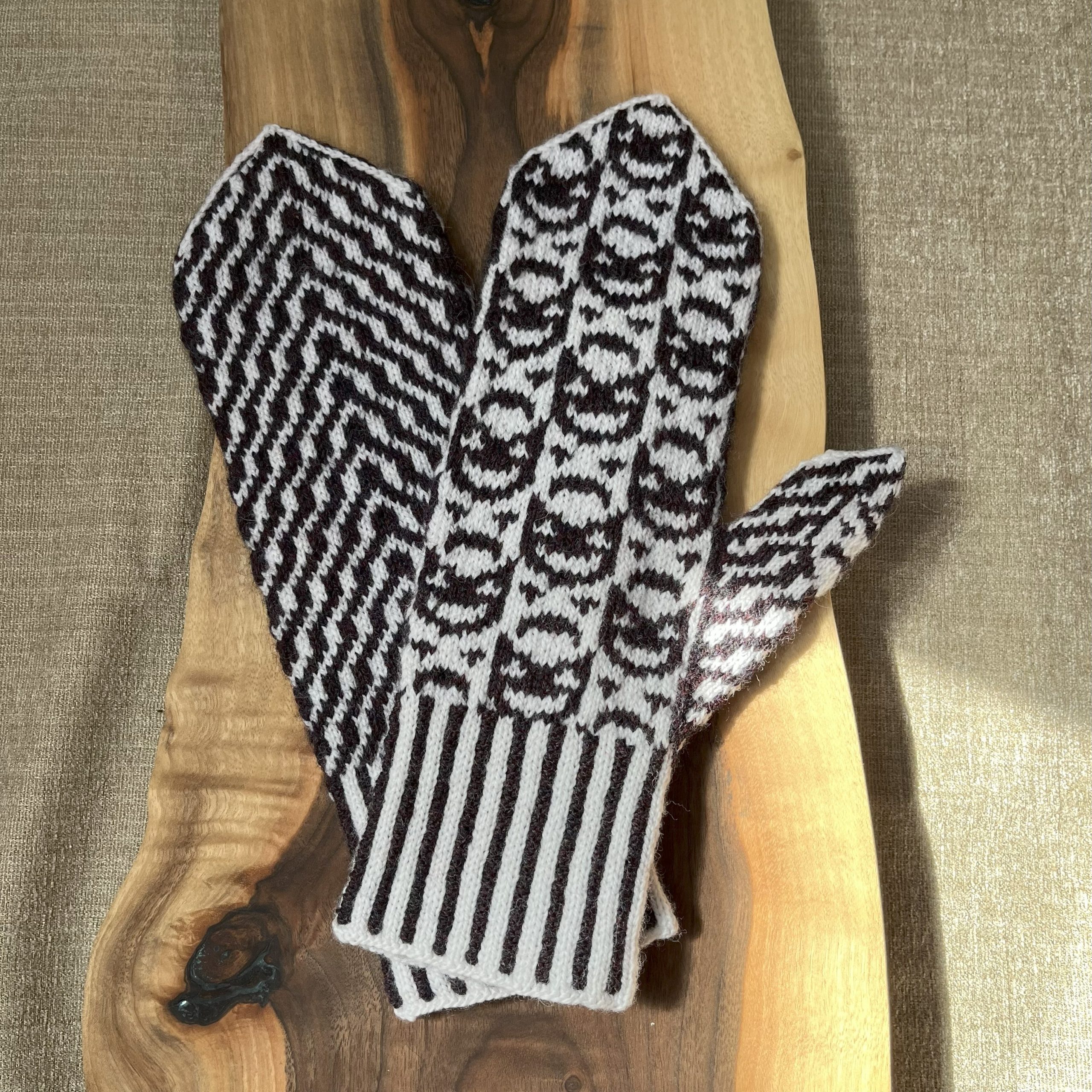
My latest design is my Comedy and Tragedy Mittens, inspired by the comedy and tragedy masks, also known as the drama masks. A traditional pair of masks with one crying and one laughing that evoke different emotions, depending on your perspective and mood. As always, Stitchmastery was a huge help in getting the design out of my head and into the charts for my pattern.
Learn more about Janet:
You can find Janet’s designs on Ravelry or follow Janet on Instagram.
I’m always in awe of Janet’s talent and artistry. Thanks for profiling her work and process!