In 2017 we ran a survey of Stitchmastery users and one response particularly caught our imagination – someone told us they would like to hear from other Stitchmastery users and how they make use of the software. We’re delighted to bring you a series of interviews with designers, tech editors, magazine editors and teachers – we hope you enjoy reading them!
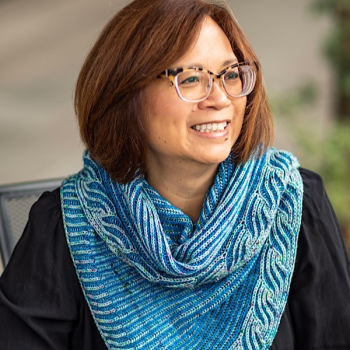
Interviewee – Michele Lee Bernstein
1) When did you start designing? Could you give us a potted history of your knitting and designing background?
I’ve been knitting since I was 14; my favorite aunt taught me to knit. My first project was a pullover sweater (jumper), knit in the round, with cables up the front. But Aunt Rose didn’t believe in gauge swatches, so it was enormous. I eventually felted/fulled it, and then it was short, boxy, and my head couldn’t get through the neckline. Oops. I’ve learned a lot about knitting and blocking since then. I love designing and knitting accessories where gauge is not critical! I’ve also learned that I have a two skein attention span.
I’ve always loved tinkering with my knitting, so that was the springboard to my designing. I’ve been designing paid work since 2008, when Ravelry made it possible for independent designers to easily self-publish our work.
I was invited to teach at a local yarn shop around the same time I started publishing on Ravelry, and that’s when I discovered how much I love teaching knitting. I teach at festivals like Vogue Knitting, Red Alder Fiber Arts Retreat, and Oregon Flock and Fiber Festival. I also teach for guilds, local yarn shops, and I’ve taught on cruises for Vogue Knitting, too.
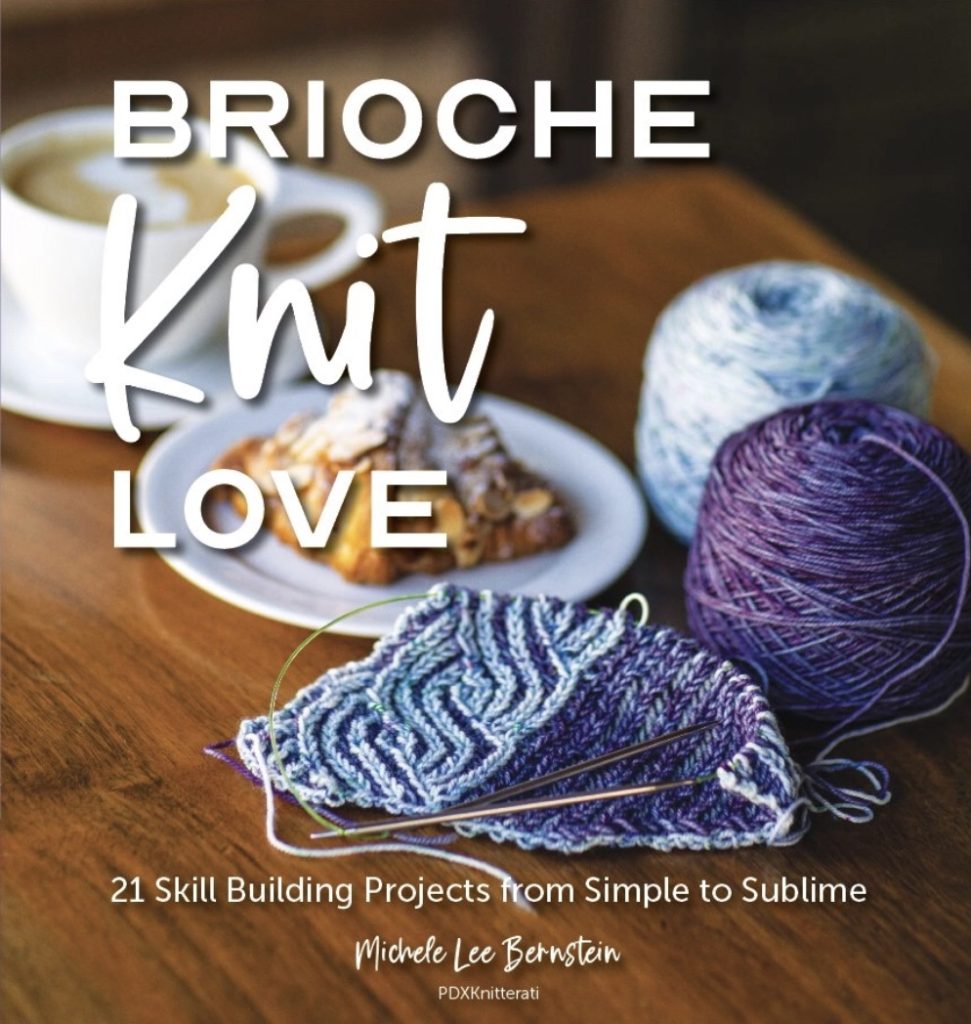
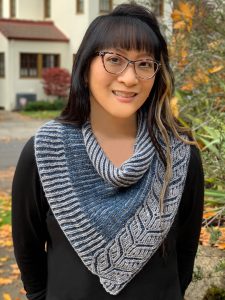
I fell in love with brioche knitting in 2017, and it’s been a deep dive since then! I wrote a book in 2021, Brioche Knit Love: 21 Skill Building Projects from Simple to Sublime. It sold out, my publisher closed, and now I self-publish it. It’s available through Amazon through most countries. I used Stitchmastery for all the charts in Brioche Knit Love.
2) Do you have any recurring sources of inspiration or unusual muses for your design work?
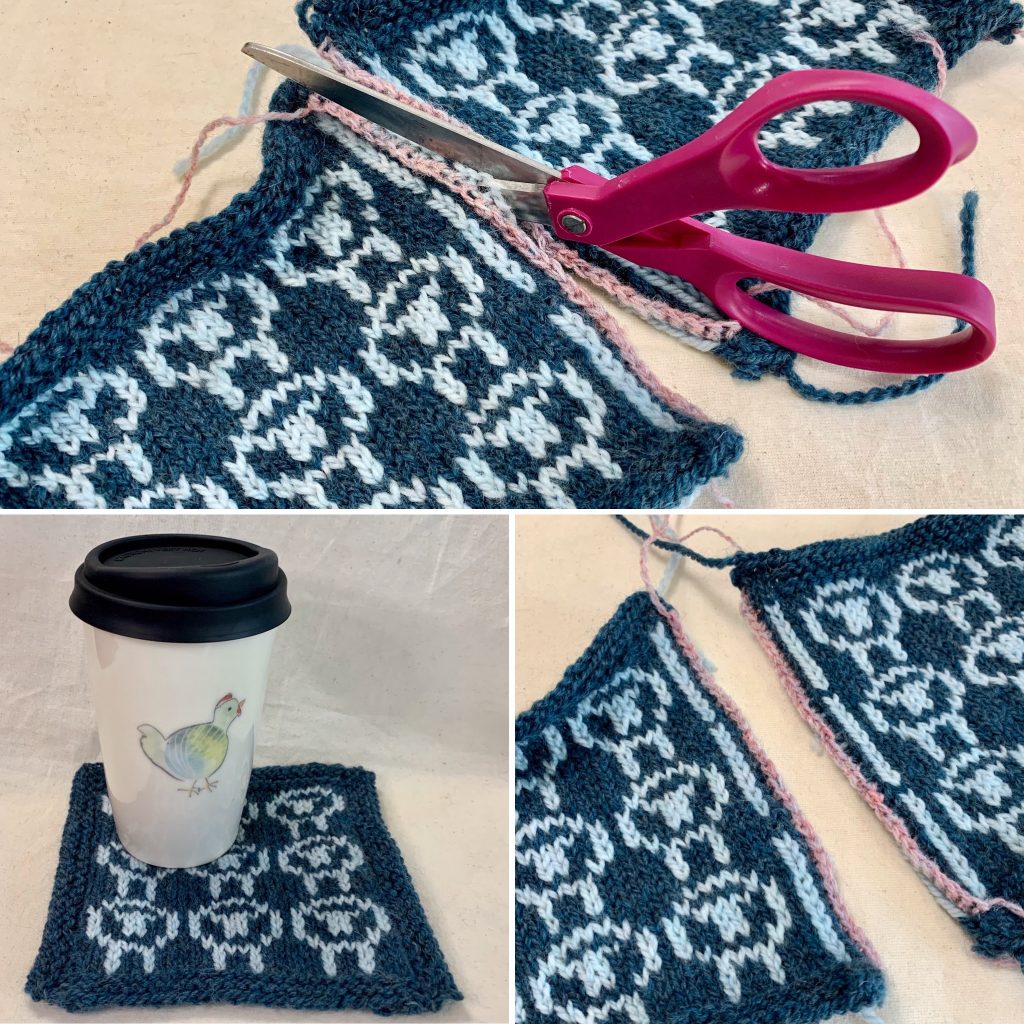
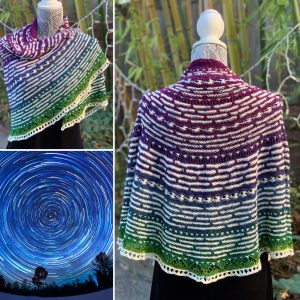
I’m technique driven most of the time. I’ll find a technique that calls to me, like brioche or assigned pooling, and then find yarn to make whatever it is that I’m dreaming about. A lot of times, I’ll design a piece because I want to teach a technique in class. I’ve done this with brioche, entrelac, steeking, slip stitch knitting, and assigned pooling.
I’m also really drawn to nature imagery, such as leaves, flowers, stars, whale tails!

3) When you have an idea, do you always work to a set workflow (eg swatch-knit-chart or chart first then knit) or does your approach change with each design?
My workflow changes from design to design. Sometimes it’s swatch-knit-chart, and sometimes I chart and then knit. And there’s usually a lot of ripping and starting over! I like to think that every project is the real project, until it becomes a swatch because it didn’t quite work out. I learn a lot from each of those swatches. I make the mistakes so you don’t have to!
4) What made you choose to use Stitchmastery? Is there a particular feature you use most regularly or couldn’t do without? And is there anything you wish Stitchmastery could do?
I chose Stitchmastery because it has brioche stitches. I previously used other software which was becoming outdated and no longer supported, and it had no brioche stitches. When brioche became my true love, I needed Stitchmastery to help me do my work.
I love that I can re-name the stitches in the key. I have a particular way of naming my brioche decreases, and I can do that in Stitchmastery. And if the stitch I want isn’t in Stitchmastery, I can re-purpose a symbol to be what I need it to be. There is so much more to Stitchmastery than what I use. I need to take some time to learn more, but it’s so easy to just use it with my so far limited knowledge. I love that I can chart my design and have it write out written instructions for me; that makes it so much easier to make sure my written instructions are accurate. I know my tech editor appreciates that, too.
I think if there were one thing I’d love to see added to Stitchmastery, it would be the ability to fill in a background of brioche stitches. Then I’d just add increases and decreases where I want them. But I’ve also saved a template of basic brioche, so I’m halfway there already. I’d also love to see a symbol for a brioche 4 stitch increase (br4st inc) and brioche 4 stitch decrease (br4st dec). I think you’ve covered the rest of the brioche stitches that I use.
5) Please tell us about your latest publication or next exciting project!
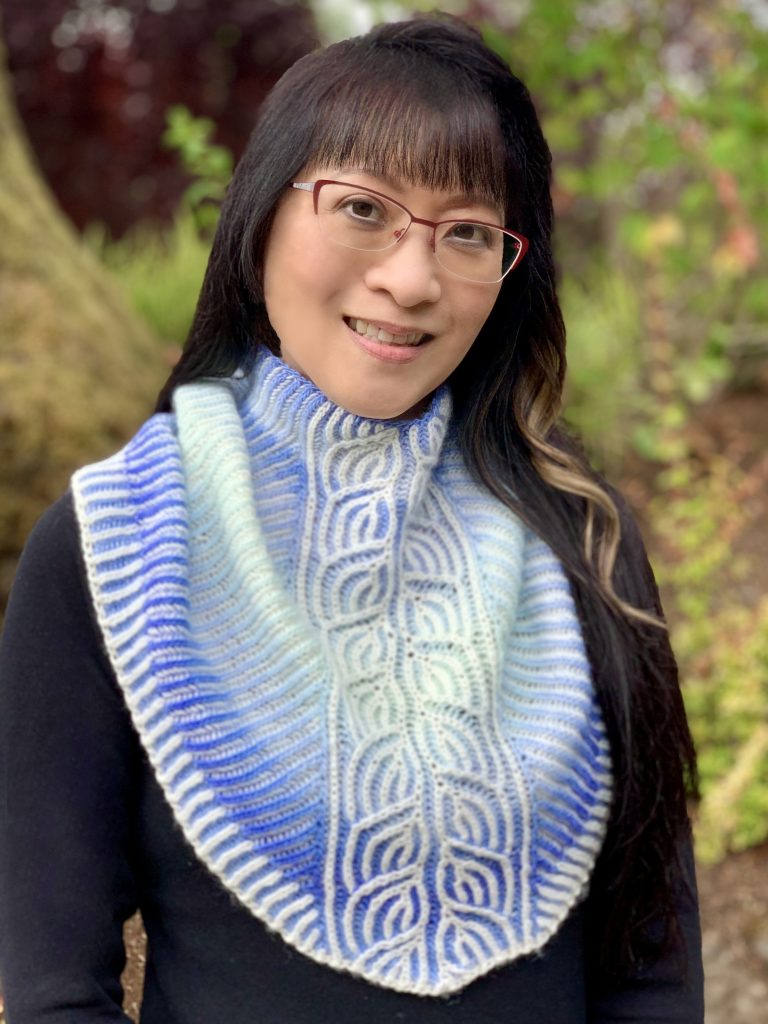
My newest design is Trailing Leaves, a brioche cowl knit in the round. It features a central leafy panel of syncopated brioche. I used Stitchmastery for charting the leafy motif. This pattern is available through Ravelry, Payhip, and Knit Picks.
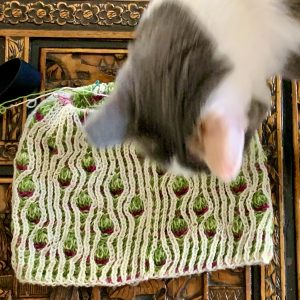
I’m currently working on a design that incorporates brioche and assigned pooling, and I’ve used a Stitchmastery chart to illustrate the assigned pooling motif. A picture is worth a thousand words! I’m so happy that I have Stitchmastery to help me.
Learn more about Michele: You can find Michele’s designs on her website, via Michele’s designer page on Ravelry or on Michele’s Payhip site , and you can keep up to date with Michele on Instagram or visit Michele’s Facebook page.
Photo credit: headshot by Angela Watts of Tekoa Rose Photography.