
The latest version of Stitchmastery (3.2.0 and beyond) has some important new features for handling two-pass pattern stitches. These are pattern stitches which are worked with two different yarns (usually two different colours) that require you to work twice in the same direction.
Two-colour brioche is a popular example. You go across the row with the first colour, working half the stitches (give or take) with that yarn, and slipping the other half, leaving them unworked. You then go back to the start of that row, without turning – a double-pointed or circular needle is important here so you can just return to the beginning without moving any stitches – and then go across with the second yarn, working the stitches that had just been slipped, and slipping the stitches that had just been worked.
Then, after those two passes, you turn your work so that you’re ready to come back on the other side. You will work the yarns in the same order on both sides – if you’re using, for example, grey and white, and you use grey first on the right-side rows, you’ll use grey first on the wrong-rows, too.
Slipped-stitch colourwork (also known as mosaic knitting) works the same way, too.
This means that the charts need to be a bit different – you have to have two consecutive rows starting at the right-hand side of the chart, then two consecutive rows starting at the left-hand side.
Here’s the chart for one of my favourite slipped stitch colourwork patterns: vertical stripes!
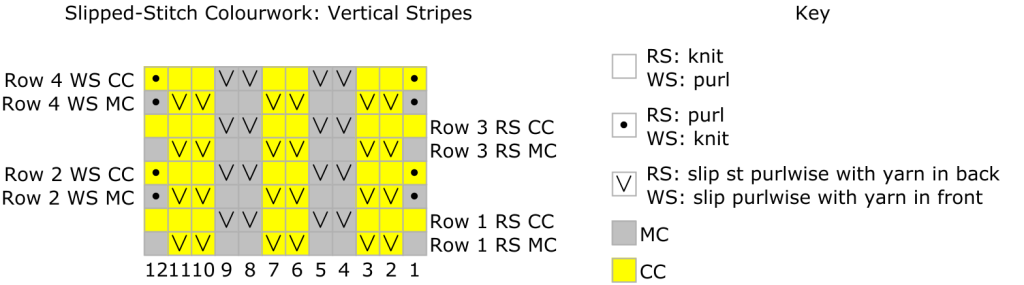
You’ll see that it starts on the RS, and on both RS and WS, you work with the MC – the grey – first.
As is pretty common for these types of patterns, there’s a selvedge stitch, which is worked with both yarns each side, but otherwise the stitches alternate. On the first pass of Row 1, working with MC, you knit stitches 1, 4 and 5, 8 and 9, and 12; stitches 2 and 3, 6 and 7, 10 and 11 are not worked with the MC, but rather just slipped.
Then you go back and work with CC, the yellow yarn. Again, the selvedge is worked, stitch 1, and you’re now going to knit the stitches that you had previously slipped – specifically stitches 2 and 3, 6 and 7, and 8 and 9.
And then the same thing repeats on the WS rows, but you’re purling instead of knitting.
The chart shows two colours on each row, but you really are only working with one – you’ll notice on the CC rows, any stitch that’s in grey is not worked, but just slipped; on the MC rows, any stitch that’s shown in yellow is not worked, but just slipped.
I love slipped-stitch colourwork because it feels like cheating: you create stitch patterns that look like complicated stranded knitting, by only working with one yarn at a time. It’s a delight, and not at all tangly! (If you’ve never tried it before, grab two colours of yarn, cast on with your CC and give it a go.)
When creating a chart like this, you’ve got a few helpful options already set up.
In the “New Chart Diagram” dialogue box, select the “Two pass” option, near the bottom. By default, “First row is pass 1” is selected – that’s the most common option, used when the pattern begins with the first of the two yarns, and you’re starting the two-pass technique right away. There are some stitch patterns where you might need to specify a set-up row; selecting this other option allows you to have a starting row worked in the standard manner, with only one pass.

Pass and Row Labels
You can then specify labels for the rows and the passes, to customize the row indicators. By default, you see LC for the Pass 1 label, and DC for the Pass 2 label – those are commonly used in two-colour brioche knitting, “LC” for light colour, and “DC” for dark colour. If you’re doing slipped stitch colourwork, or indulging in my habit of using variegated yarns for brioche, those labels might not make sense. In the slipped-stitch colourwork example above I used MC for main colour and CC for contrast colour.
And if you’re working flat, it also asks for the labels for the sides. By default the system offers LS for Light Side and DS for Dark Side. This is typical for brioche since it’s a reversible fabric – it’s basically (k1, p1) ribbing.
In the brioche chart below, you can see what it looks like if you use the defaults for those labels:
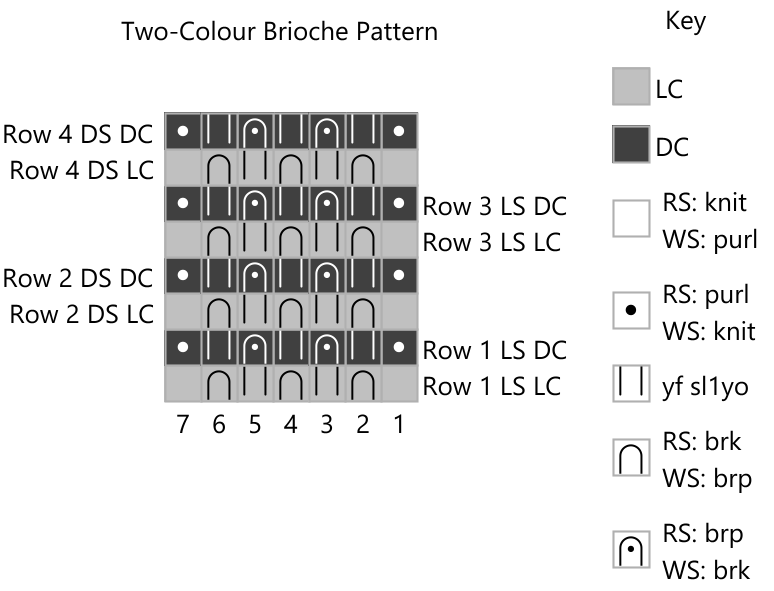
In the New Chart Diagram image below, I’m changing both the names of both the passes and the labels for the rows – this is how I set things up for the yellow and grey colourwork example above, with RS for right side and WS for wrong side.

A note re the number of rows: the number you input is the total number of passes worked. In both of the examples here, I have asked for 8 rows, which gives me two passes each of Rows 1, 2, 3 and 4.
The Written Instructions
And there’s a difference, too, in the written instructions that are generated. (I have to say, the ability to generate written instructions for a chart is one of my favourite features of Stitchmastery.)
Chart Two-Colour Brioche Pattern

Row 1 LS LC: K1, (brk, yf sl1yo) × 2, brk, k1. Do not turn. (7 sts)
Row 1 LS DC: P1, (yf sl1yo, brp) × 2, yf sl1yo, p1. Turn.
Row 2 DS LC: P1, (brp, yf sl1yo) × 2, brp, p1. Do not turn.
Row 2 DS DC: K1, (yf sl1yo, brk) × 2, yf sl1yo, k1. Turn.
Row 3 LS LC: K1, (brk, yf sl1yo) × 2, brk, k1. Do not turn.
Row 3 LS DC: P1, (yf sl1yo, brp) × 2, yf sl1yo, p1. Turn.
Row 4 DS LC: P1, (brp, yf sl1yo) × 2, brp, p1. Do not turn.
Row 4 DS DC: K1, (yf sl1yo, brk) × 2, yf sl1yo, k1. Turn.
Look at that magnificent “Do not turn.” at the end of the LC passes, and “Turn.” at the end of the DC passes. Fabulous!
As always, the chart key can be edited manually, and the stylesheet for the written instructions can be tweaked to your standard format. For example, I tend to prefer “2 times” rather than “x 2”, but that’s adjustable in your written instructions stylesheet, available through the “Edit Diagram Properties” dialogue box.
In the Round
Two-pass pattern stitches can also be worked in the round. In this case, you still need to think about labels for the passes, but there’s no need for labels for the two sides.
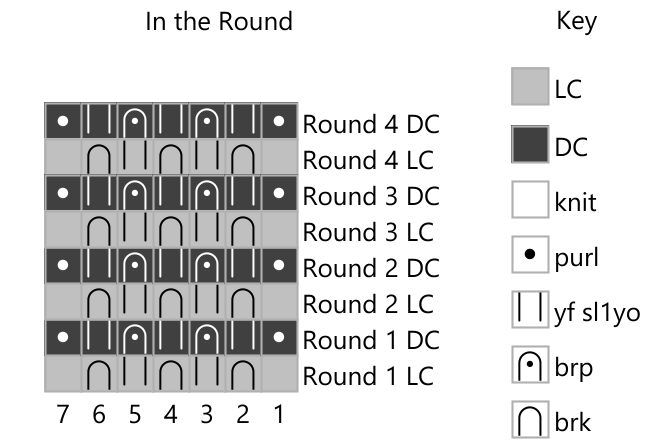
If you are still using Stitchmastery versions 3.0.0 to 3.1.0, please refer to Kate’s previous articles on brioche & fisherman’s rib and slipped-stitch colourwork which will help you with the settings.