In 2017 we ran a survey of Stitchmastery users and one response particularly caught our imagination – someone told us they would like to hear from other Stitchmastery users and how they make use of the software. We’re delighted to bring you a series of interviews with designers, tech editors, magazine editors and teachers – we hope you enjoy reading them!
Interviewee – Emma Vining aka Purlemma
1) When did you start designing? Could you give us a potted history of your knitting and designing background?
I first started to learn to knit at home with my Mum and then at primary school when my whole class was taught how to knit teddy bears and fingerless gloves. Since then, I have never stopped knitting and learning about knitting! After completing a City and Guilds Diploma in Hand Knitting Design, I began to submit design ideas for publication in magazines.
I recently reached, and passed, a major milestone of 150 published knitting patterns! My garment and accessory patterns include commissions from magazines such as The Knitter and Knitting, through to self-published designs where I work in close collaboration with independent hand dyers and yarn producers. I really enjoy working with a wide range of different companies and individuals as I always learn from each project and find new ideas for my designs.
As well as designing for magazines and yarn companies, I am the author of two books about knitting design, both published by The Crowood Press. My books are full of suggestions for knitting inspiration, enabling readers to create their own personalised designs. This inspiration ranges from ideas for new techniques, sources for designs and suggestions of new ways to create pattern. My first book, A Knitter’s Sketchbook, explored these ideas through cable knitting and my second book, A Knitter’s Guide to Shawl Design, places this idea of working from inspirational sources in the context of shawls.
2) Do you have any recurring sources of inspiration or unusual muses for your design work?
I find inspiration for my designs from a wide range of sources from the world all around me, from nature to the urban environment. I develop my ideas with sketches and photographs and translate them into knitting, often using Stitchmastery charts as an integral part of my design process.
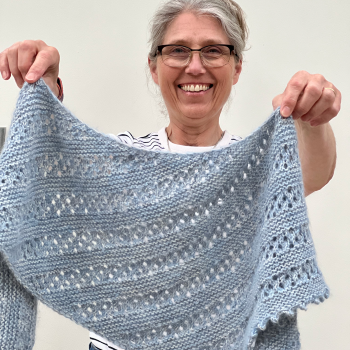
A recent example is my Gentle Rain Shawl [pictured top and below] which is inspired by poems about the natural world. Emily Dickinson (1830-1886) wrote almost 1800 poems during her lifetime and many of her poems contain detailed references to the natural world and the weather. The Gentle Rain Shawl represents the individual raindrops that often precede an intensive rain shower, such as those mentioned in the poems “A Drop Fell On The Apple Tree” and “Like Rain It Sounded Till It Curved”.
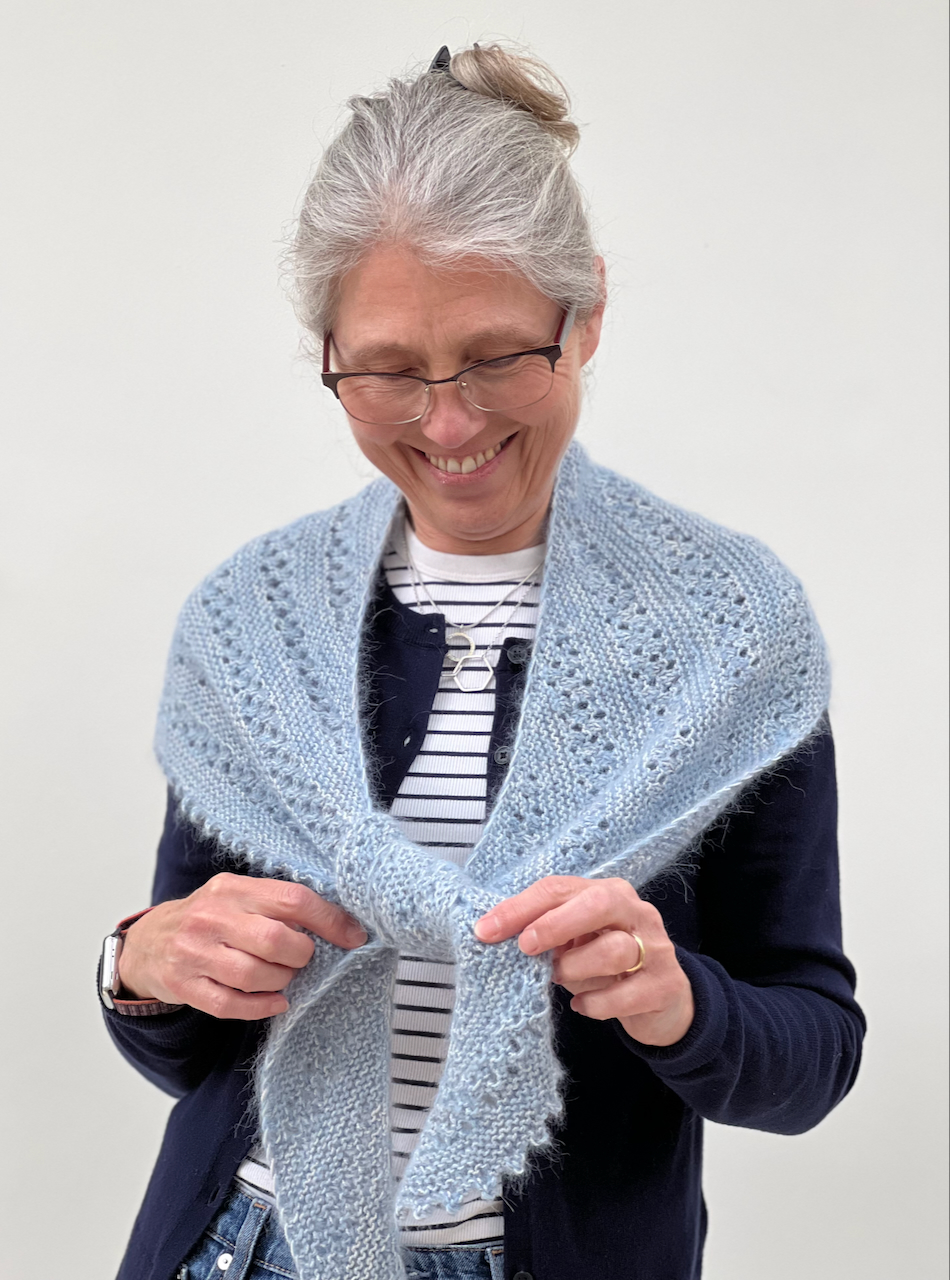
The shawl stitch pattern builds up gradually from textured eyelets worked within garter stitch to larger eyelets on a stocking stitch background. Each stitch pattern represents the changing intensity of a rain shower, with the final drops worked as a picot cast off edge. The shawl’s curving asymmetric shape is created by knitting a right-angled triangle on the bias. I used Stitchmastery charts to plan the whole shawl and the stitch pattern placements for each section of raindrops. For the published pattern I included small charts alongside the written instructions to help knitters visualise each stitch pattern. The shawl is knitted with one skein of merino silk 4ply yarn and one skein of alpaca silk lace yarn held together throughout, with the alpaca fibres gently blurring both the yarn shades and the stitch patterns. The beautiful yarns are hand dyed by Irish Artisan Yarn.
A second example, this time from the urban environment, is my Leadenhall sweater pattern. Leadenhall is inspired by my love of architectural structures and in particular, staircases! I have a large collection of staircase photographs from many different buildings and locations and I use these as inspiration for many different patterns. The zigzagging stitch pattern of the Leadenhall sweater is based on a staircase which changes in direction at each building level. The flip tool in Stitchmastery allowed me to mirror-image the staircase zigzags and the resulting chart is knitted as a pattern panel on the front and back of the sweater. The Leadenhall sweater is knitted with Cat and Sparrow’s beautiful Oh So Fine DK yarn. The main shade of Spice Market contrasts beautifully with the lighter shade of Sleeping Dragon and the result is an eye catching and stylish garment.
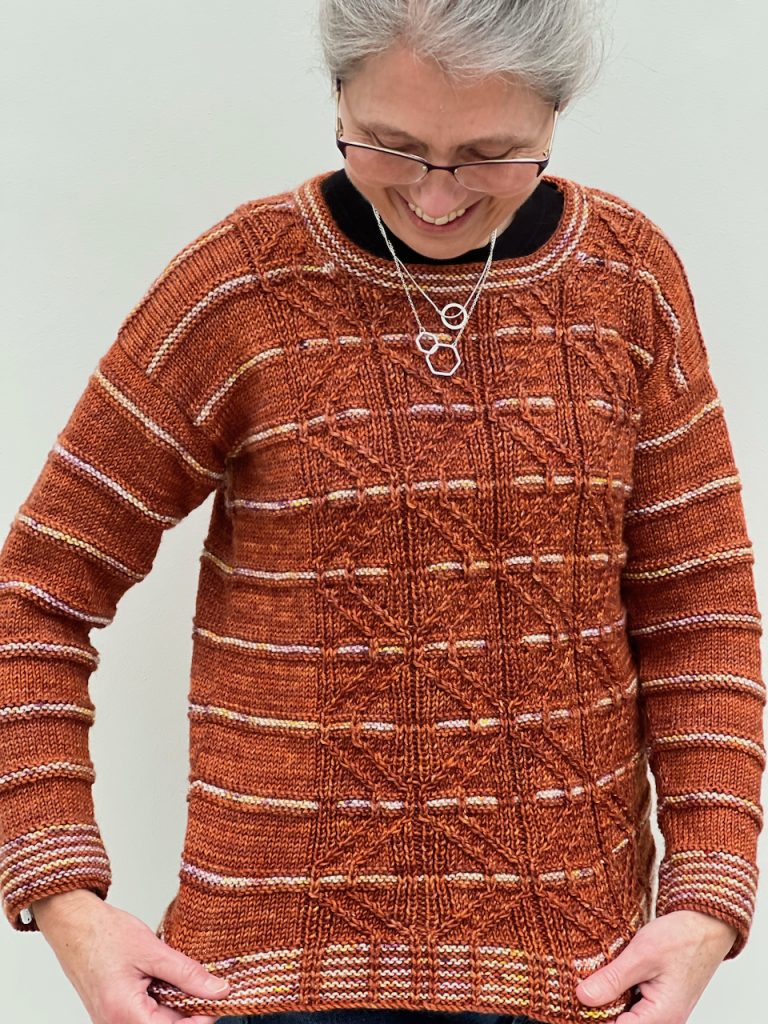
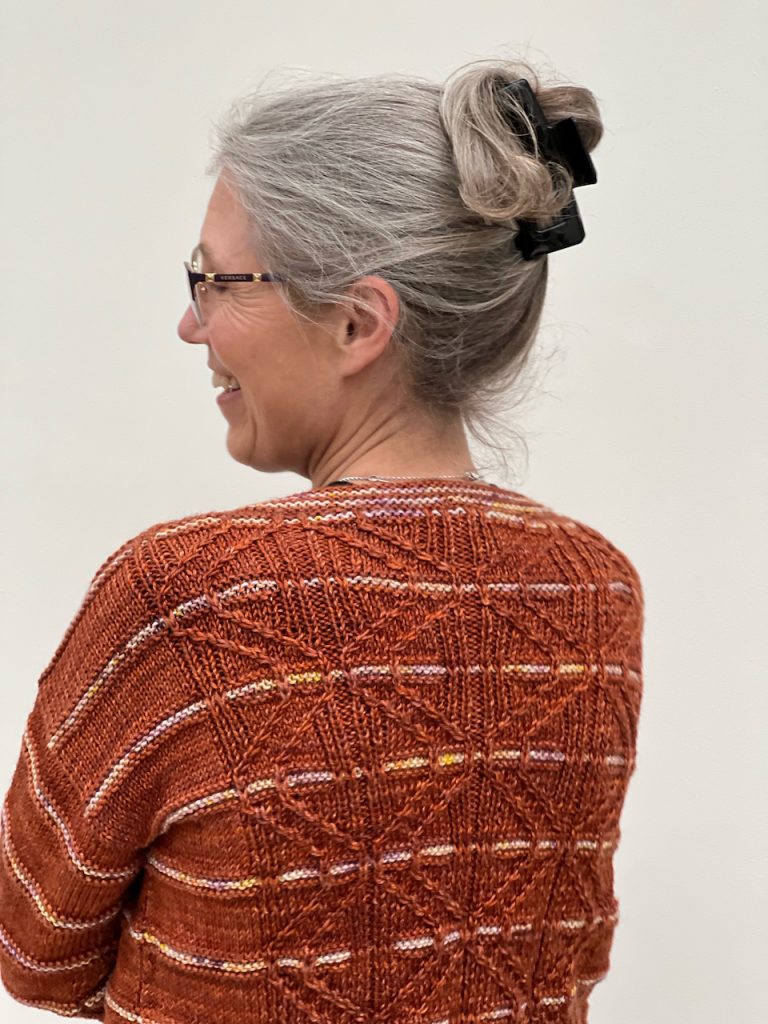
Both patterns are now available in my Ravelry and Payhip stores [links below] and there is a discount of 20% off the full pattern prices until Sunday 3rd November 2024!
3) When you have an idea, do you always work to a set workflow (eg swatch-knit-chart or chart first then knit) or does your approach change with each design?
Once I have decided on the source of a design, I often begin with sketches of my ideas. Even just a few brief sketched lines on a page can be very helpful to remind me of my initial thoughts. From my sketches, I’ll then go on to chart the pattern using Stitchmastery. This helps me visualise where my stitches will be placed and allows me to get my idea onto my knitting needles. I’ll then make changes to my knitting and the chart as I work out the best way to translate my design ideas into yarn.
4) What made you choose to use Stitchmastery? Is there a particular feature you use most regularly or couldn’t do without? And is there anything you wish Stitchmastery could do?
I began using Stitchmastery when I was writing my first book, A Knitter’s Sketchbook. My book is all about drawing on your knitting with travelling stitches such as cables and twisted stitches. Large cables are like my marker pens and twisted stitches are my fine-liners and there is a cable stitch for every pen and pencil width in-between! Stitchmastery helped me chart all my cable stitch patterns and to create written instructions at the same time.
Although there was a symbol for almost all the major cable techniques, my proudest achievement during that time was creating custom stitch symbols for reverse stocking stitch cables! I watched the really helpful Stitchmastery video tutorial several times, pausing it as I went along and then working out how to save my new cable symbols.
5) Please tell us about your latest publication or next exciting project!
In early 2025, I’ll be co-hosting a series of online workshops and a KAL with Liz and Louise of The Loom Shed! This is our third edition of this very enjoyable event and this year’s subject is “Drawing on Your Knitting with Cables”.
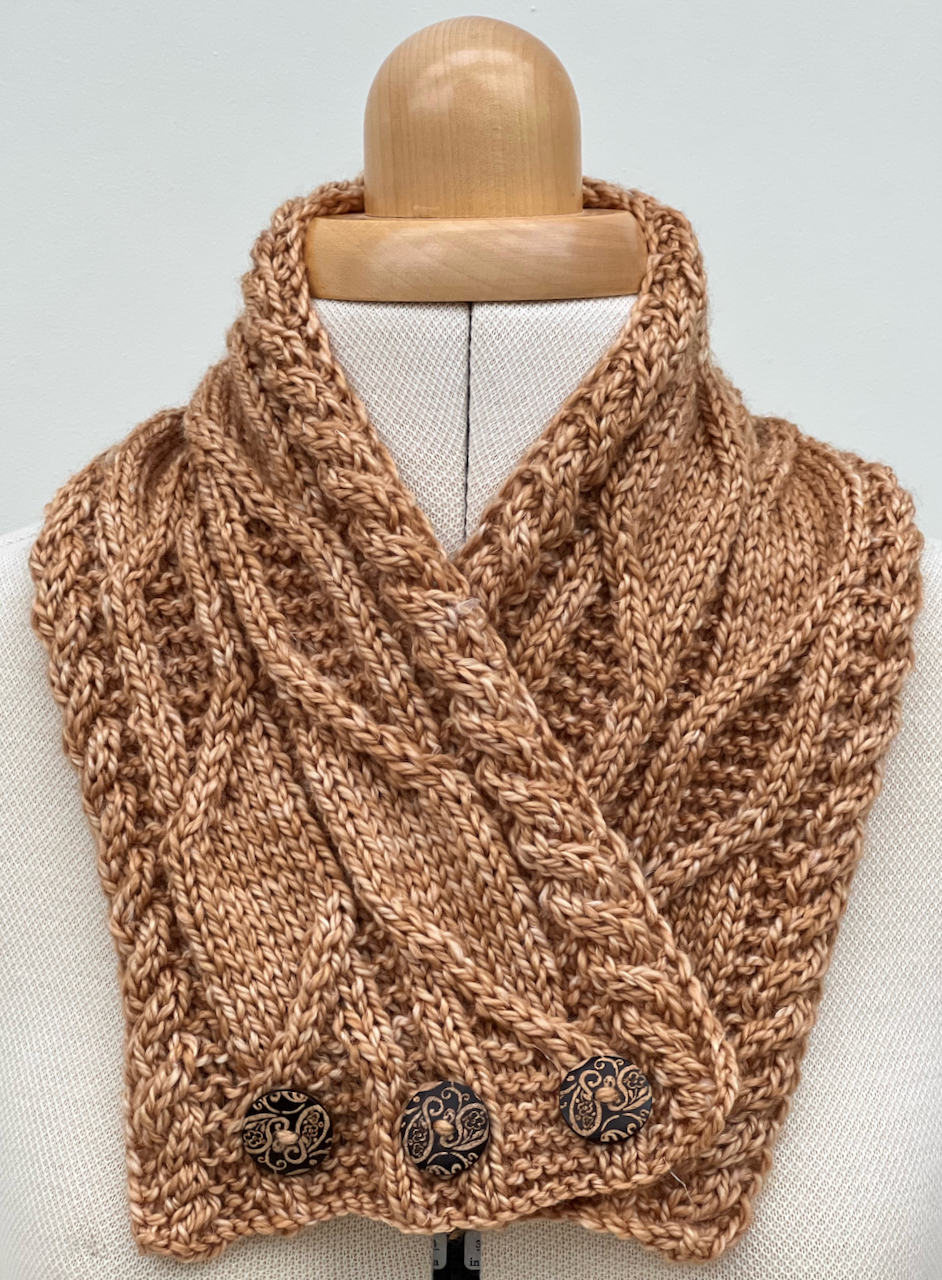
Over four one-hour zoom sessions we’ll knit my Little Leaf Cable Cowl pattern together, customising the cowl pattern with texture, twisted stitches and reverse side cables. A new leaf stitch pattern will be introduced at each session with charted and written instructions provided, created using Stitchmastery of course! These instructions are fully compatible with the Little Leaf Cable Cowl pattern allowing participants to mix and match their stitch patterns. The Little Leaf Cowl shown is knitted with 1 x 100g skein of Eden Cottage Yarns Keld Aran. Participants can use any of the beautiful aran yarns by Eden Cottage Yarns or an aran yarn of their choice. Booking is now open for the workshops and it would be fantastic if your blog readers would like to join us in the New Year!
Learn more about Emma: You can visit Emma’s website and her patterns are available via Emma’s designer page on Ravelry or on Emma’s Payhip site. You can keep up to date with Emma on Instagram, visit Emma’s Twitter page or Emma’s Pinterest page.